Algebra I
-
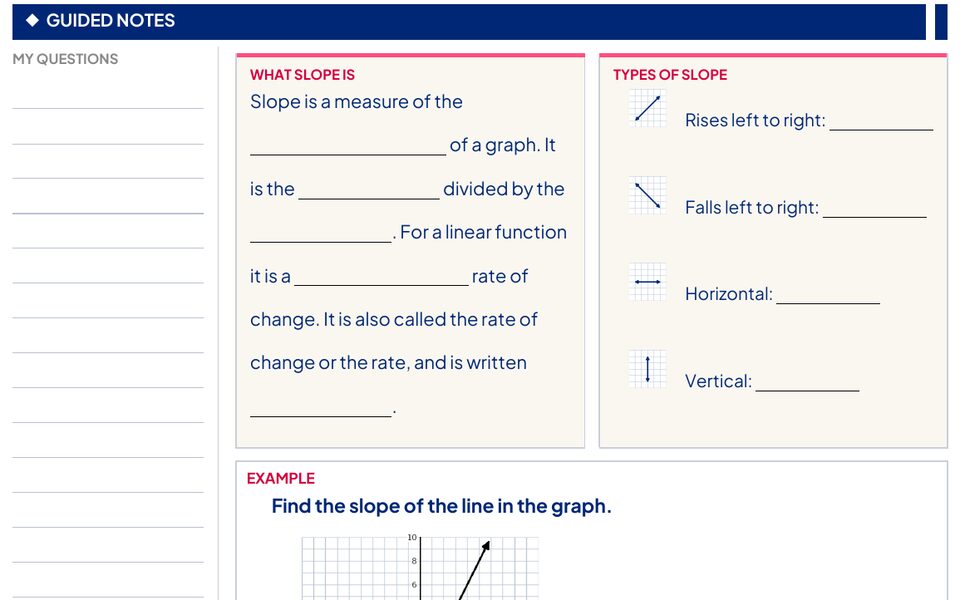
Guided notes with a Cornell cue column
Fill-in notes keep students on the mathematics instead of copying. The ruled cue column is empty on purpose: students write their own questions there and study from them.
-
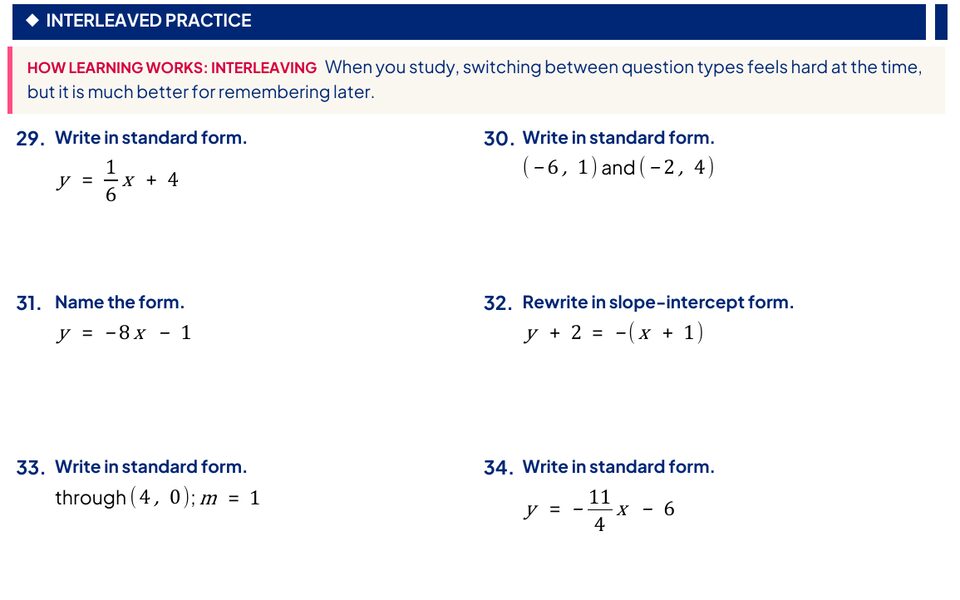
Interleaved Practice in every lesson
9 to 12 mixed problems, about 80% from the current lesson and 20% from earlier ones. Each names the question but not the method, because choosing the method is the skill interleaving trains.
-
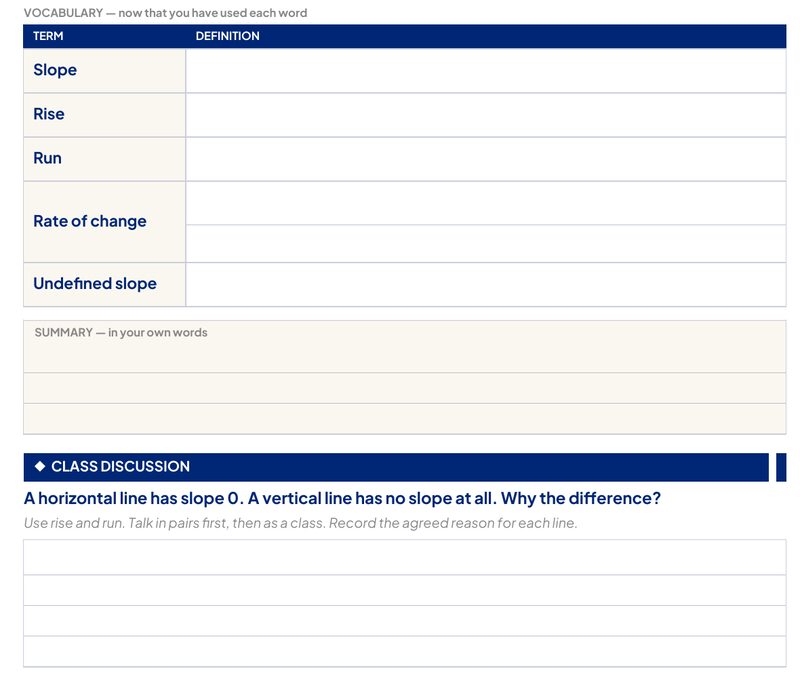
Vocabulary after use, then a summary in their own words
Students define terms only after they have used them in examples, write a summary in their own words, then settle a discussion question in pairs and as a class.
-
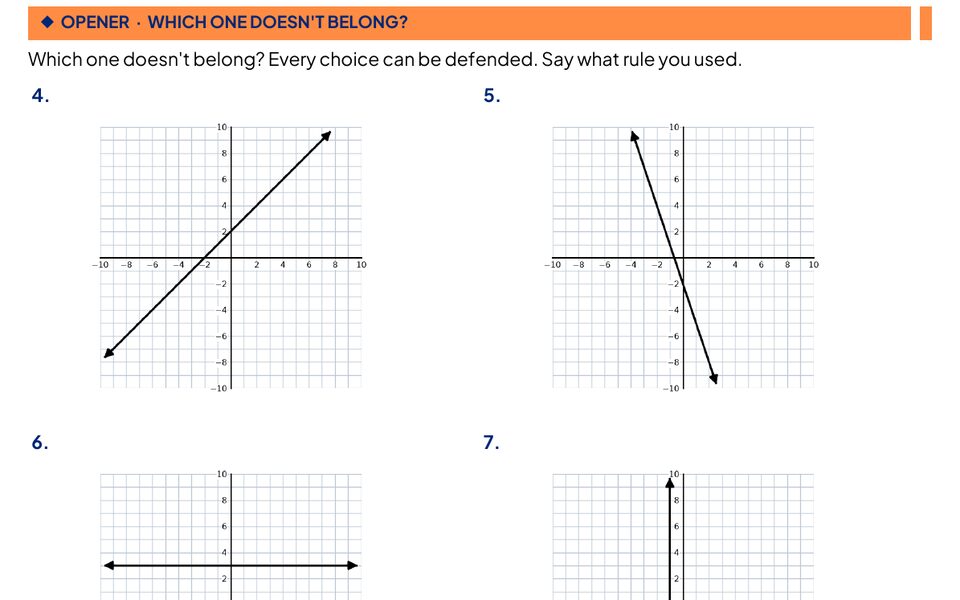
Unit 4, Linear Functions: lesson packets
Fourteen lessons from slope to lines of best fit, each with a warm-up, an open-ended opener, guided notes and practice, written for my Algebra I course.
-
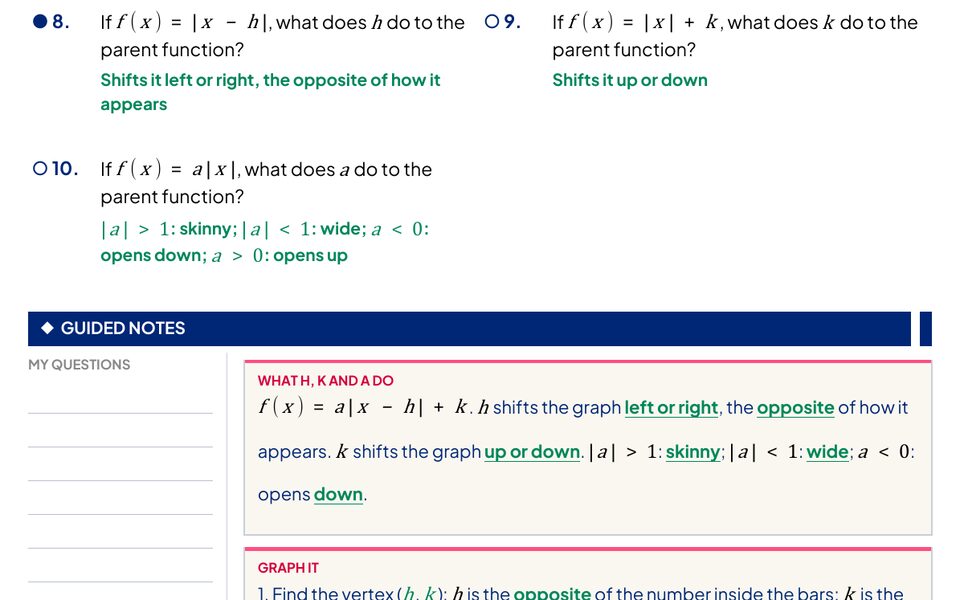
Teacher editions for every lesson
Worked answers and completed notes on the same layout students see, so a co-teacher or substitute can teach the lesson as planned.
-
Student-centered Algebra I on 1:1 iPads
Desmos and Amplify Classroom activities let students explore a family of functions before the notes, and let me see every student's thinking live and pull examples to discuss.
-
Thousands of original problems
I write my own practice sets and question banks, with several genuinely different versions of each question type for retakes and review.


Differentiation and gifted
-
Accelerated math pathway
I compiled the placement data and led the creation of permanent 6th-grade Pre-Algebra and 7th-grade Algebra I courses. Those students went on to a 100% Keystone pass rate, with over 90% Advanced.
-
Co-teaching with pre-tests and flexible groups
In co-taught 6th-grade math, Pre-Algebra and Algebra I, unit pre-tests decide the groups, and students move between groups as the unit goes on rather than staying in one track.
-
Placement and scheduling
I analyze testing data to recommend course placement and serve on the scheduling committees that turn those recommendations into sections.
-
Gifted IEPs
I write and implement GIEPs for the gifted students on my caseload.
-
Grades 6–8 enrichment program
Problem solving, electrical circuits, programming in Python, Swift and MicroPython, and hands-on science for gifted middle school students.
Assessments
-
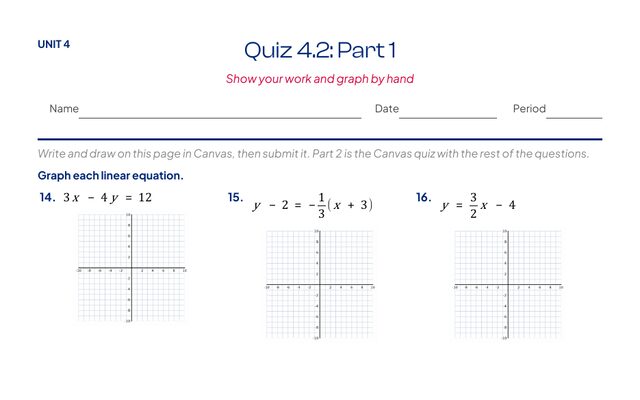
Two-part unit quizzes
Part 1 is graphed and shown by hand so I can see the reasoning; Part 2 runs in Canvas for instant feedback on the rest.
-
Keystone preparation
I write Keystone-aligned practice and review the questions students miss most, then reteach those skills directly.
Watch: Top 5 Most Missed, Linear Equations & Inequalities -
Curriculum review
I have reviewed dozens of math curricula, looking at how each one builds a skill across a unit and how its assessments measure it.

Lesson videos
I have recorded more than 100 instructional math videos. A selection:
Absolute Value Inequalities: "Less Than" Means "And"
Keystone Top 5 Most Missed: Linear Equations & Inequalities
Is It a Function? (From a Graph)
Graphing in Slope-Intercept Form
The Many Meanings of Minus
Systems of Equations by Elimination
Systems Applications: Mixture Problems
Factoring Trinomials with a ≠ 1
Competitions
-
Future Problem Solving: 2nd in the world, 2026
A Thomas Jefferson team I coach placed 2nd in the world in the Middle division at the 2026 International Conference.
FPS Pennsylvania results TribLive, July 21, 2026 -
Coach since 2010, Pennsylvania Affiliate Director since 2020
My teams have won dozens of state titles and placed 2nd, 3rd, 4th and 8th in the world. As Affiliate Director I run the state program for over 300 students each year across many districts.
-
State championships in the news
The Messenger covered our teams sweeping every division in 2016, taking 1st, 2nd and 3rd in 2018, and winning the Senior division in 2023.
2016 2018 2023 -
MATHCOUNTS, CalcuSolve and Science Bowl
I have also coached math and science competition teams in MATHCOUNTS, CalcuSolve and Science Bowl.